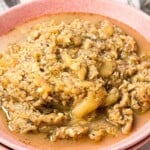
Kousa Cores (Lebanese Cooked Squash Filling)
A savory and tangy Lebanese side dish that transforms leftover Kousa squash filling (cores) into a mouthwatering vegan sauté with garlic, mint, and pomegranate molasses.
Servings: 4 servings
Ingredients
- 3 cups Squash filling (from coring the squash)
- 1 tablespoon Olive oil
- 3 cloves Garlic minced
- 1 tablespoon Dried mint
- 1 teaspoon Sumac
- 1½ teaspoons Pomegranate molasses
Instructions
- After coring the squash for dishes like stuffed Kousa, collect the inner flesh.
- Chop the squash flesh into small, uniform pieces for even cooking.
- In a medium pan, heat the olive oil over medium-high heat.
- Add the minced garlic and sauté for about 30 seconds until fragrant.
- Add the chopped squash flesh to the pan, stirring to combine with the garlic.
- Stir in the dried mint, sumac, pomegranate molasses, and a pinch of salt.
- Reduce the heat to low and let the mixture simmer for about 15 minutes, stirring occasionally, until the flavors meld together.
- Enjoy the dish warm, either with the flavorful broth that forms or drained if preferred.
Notes
- Uniform chopping. The flesh should be chopped into small, roughly uniform pieces before cooking so it cooks down evenly. Uniform cutting ensures everything cooks at the same rate.
- Do not skip the simmer. The biggest mistake people make with this recipe is not cooking the cores down long enough. You need to let the squash flesh sauté and then simmer properly so the moisture releases, the flavors meld, and the texture becomes soft and almost silky. Rushing this step leaves the dish tasting raw and underdeveloped.
- Use generous garlic. Garlic is one of the two most important ingredients in this recipe, and using extra is actively encouraged. The garlic infused into the olive oil at the start is the flavor backbone of the whole dish.
- Never skip the pomegranate molasses. If there is one ingredient that makes this recipe taste the way it is supposed to taste, it is the pomegranate molasses. Do not substitute it, do not reduce it, and do not leave it out. It gives the dish its distinctive sweet-sour depth that you cannot replicate any other way.
- The mint matters too. Both the pomegranate molasses and the dried mint are non-negotiable. Together, they create the flavor that makes this dish instantly recognizable to anyone who grew up eating Lebanese home cooking.
- Try it cold too. I prefer it warm, but it is also genuinely delicious at room temperature or cold from the fridge, almost like a Lebanese-spiced zucchini relish. Scoop it onto bread or alongside rice, either way.
Nutrition
Serving: 4servings | Calories: 53kcal | Carbohydrates: 5g | Protein: 1g | Fat: 4g | Saturated Fat: 1g | Polyunsaturated Fat: 0.5g | Monounsaturated Fat: 3g | Sodium: 4mg | Potassium: 239mg | Fiber: 1g | Sugar: 3g | Vitamin A: 212IU | Vitamin C: 15mg | Calcium: 23mg | Iron: 1mg